
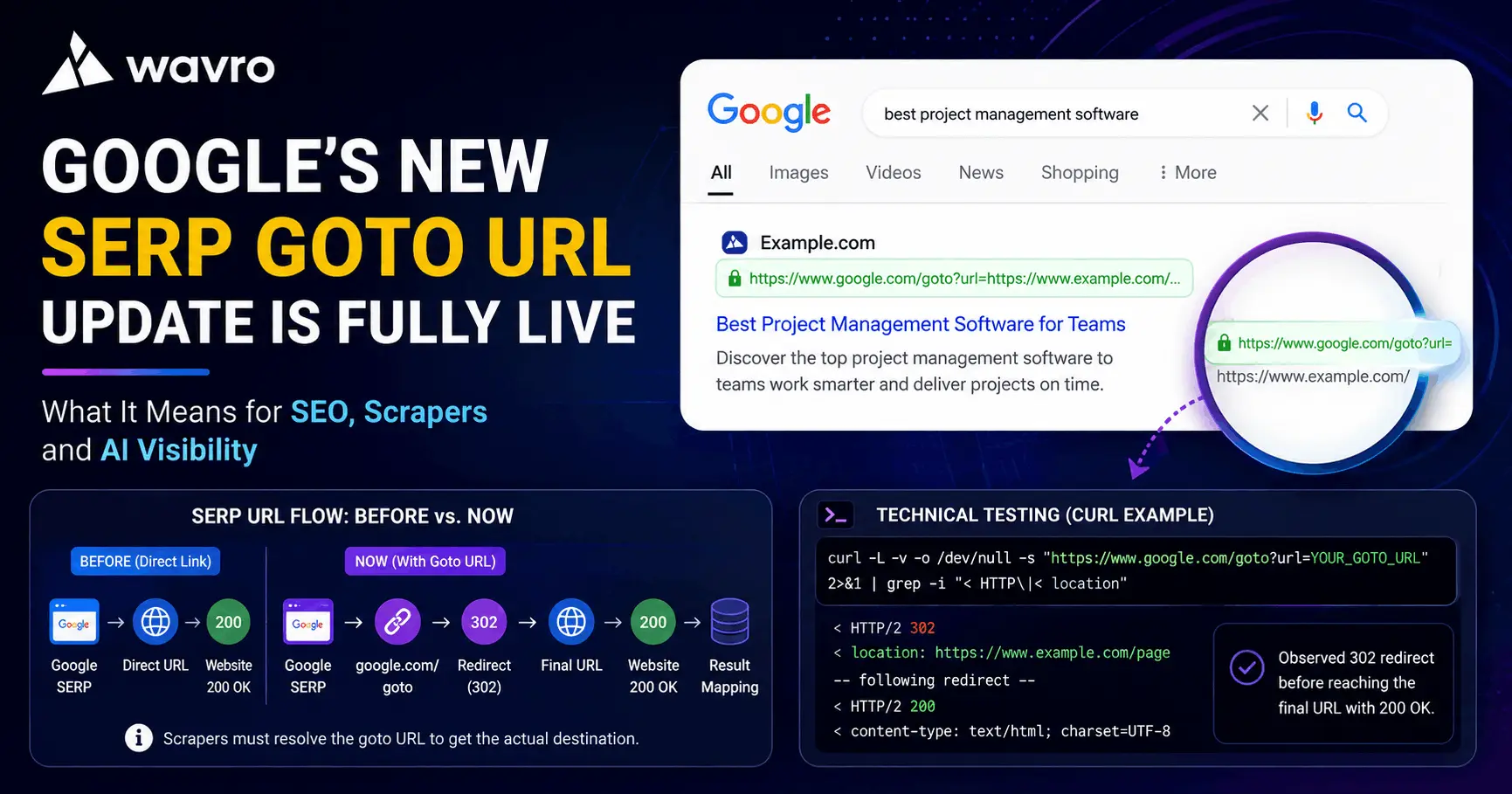
Google has rolled out a change to the links used across Google Search, AI Overviews, and AI Mode. Users will barely notice it. For SERP scrapers, SEO tools, AI visibility platforms, and any system collecting Google's search and AI result data, it changes what you have to do to get a usable URL.
What changed in Google results
When you hover over a Google result, your browser normally shows the URL that the result points to.
Previously, Google would generally link directly to the destination page:
https://example.com/page
Now, Google can use a google.com/goto URL instead:
https://www.google.com/goto?url=...
When clicked, the request first goes through Google's URL before reaching the actual destination.
The final destination URL itself has not changed. Google has changed the URL used behind the result.
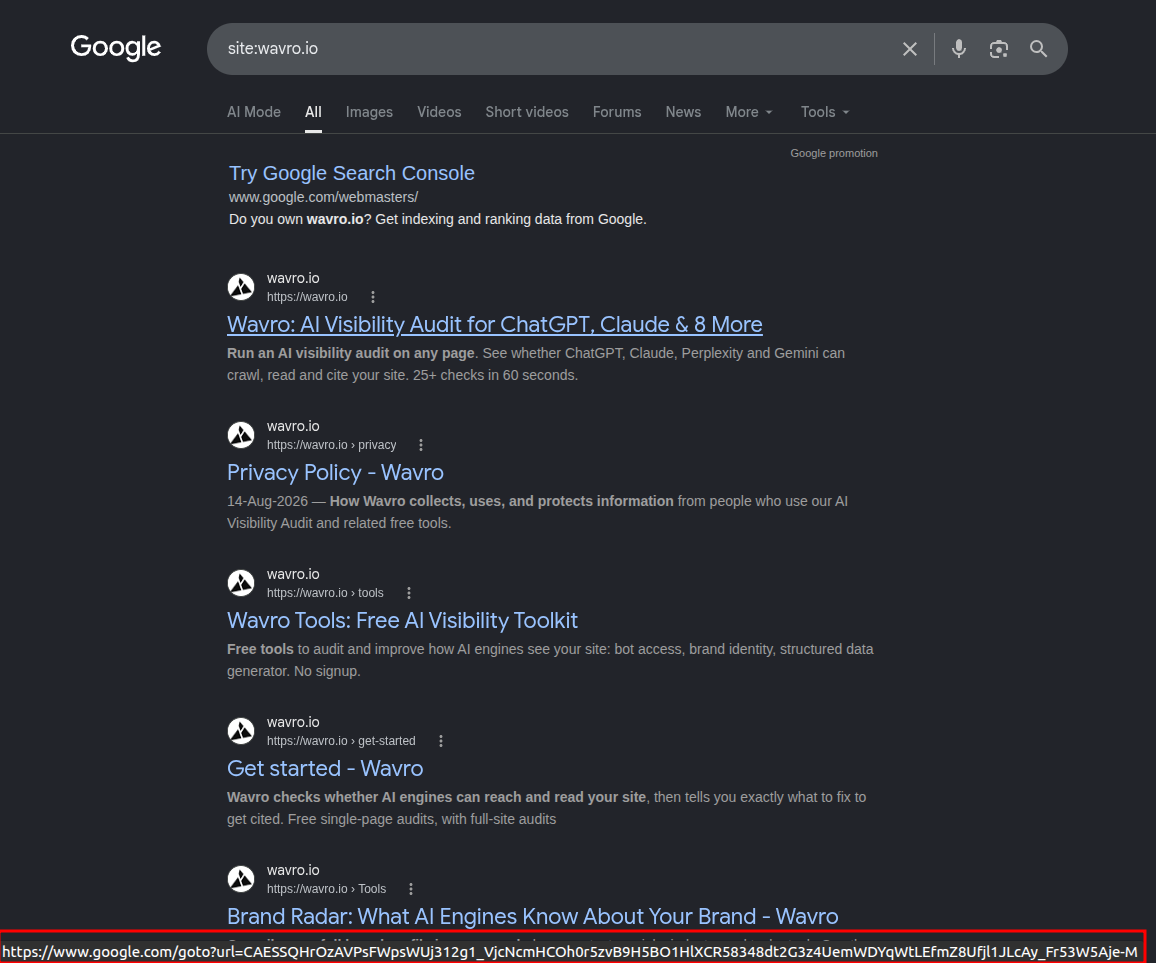
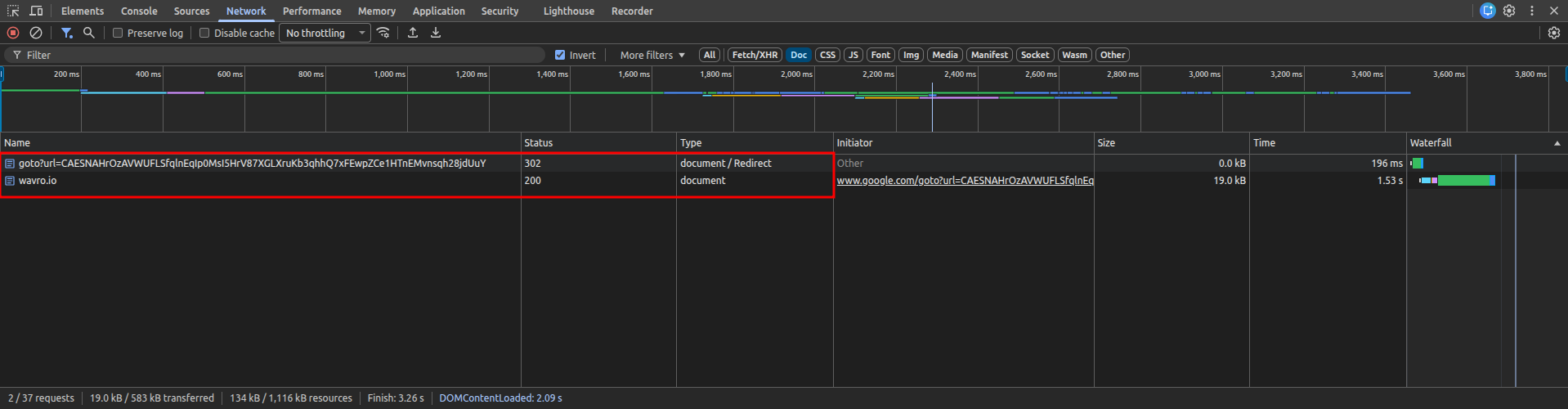
In our testing, we observed:
Google result → 302 Redirect → Final URL → 200 OK
Look closely at that url= value. It is not the destination address in percent-encoded form. It is an opaque token:
https://www.google.com/goto?url=CAESSQHrOzAVPsFWpsWUj312g1_VjcNcmHCOh0r5zvB9H5BO...
This detail matters more than the redirect itself. If the parameter held a readable URL, a scraper could simply decode it and carry on with no extra requests. It does not. Every token we captured begins with the same CAES prefix and encodes the destination in a form only Google can resolve, which means following the redirect is mandatory rather than optional.
Why Google implemented this goto tracking URL
Google is adding another layer between its search results and destination websites, making it harder for automated systems to directly extract and scrape result URLs.
This is particularly relevant to:
- SERP scrapers
- Rank-tracking tools
- SERP APIs
- Automated search-data platforms
- AI systems collecting Google result data
The additional Google-controlled URL means automated systems have another step to process before they can identify the actual destination.
In short, Google is tightening control over its SERP data, making large-scale automated scraping and URL extraction more difficult.
What this means for SERP scrapers and how they can handle Google's goto tracking URL change
The main change for scraper developers is URL resolution and result mapping.
A scraper can no longer assume that every URL extracted from a Google result is the final ranking URL. It needs to determine whether the extracted link is a Google redirect and resolve it to the actual destination.
Depending on the implementation, the scraper may need to:
- Detect
google.com/gotolinks - Follow the redirect to resolve the destination, since the token cannot be decoded locally
- Normalize the final URL
- Map it back to the correct SERP result
- Handle the additional request efficiently at scale
Because the url= payload is opaque, this is not a case where the destination can sometimes be read directly. Every goto link costs one additional network request.
At scale, even one additional request per result can increase processing time, bandwidth, and infrastructure requirements.
Before, a scraper had one hop to make. Now it has three, and the last one is yours to implement.
Technical testing using curl: verify the 302 redirect on Google's goto tracking URL
You can verify the redirect behavior yourself using curl. Capture a goto URL from a live Google result, then:
curl -L -v -o /dev/null -s "PASTE_GOTO_URL_HERE" 2>&1 | grep -i "< HTTP\|< location"
The -L option follows redirects, while -v displays the HTTP response headers. Filtering for HTTP and location makes the redirect chain easier to inspect.
This returns the same 302 to 200 chain shown in the network panel above, which confirms why scraper systems need to resolve the Google URL rather than simply storing the URL extracted from the SERP.
AI Overview sources also use Google's goto tracking URL
The change is not limited to traditional organic results.
Google AI Overviews provide links to webpages used as sources for their answers. These source links can also use Google's redirect mechanism.
For an AI visibility platform, the process can therefore look like:
AI Overview → Source Link → Google Redirect → Source URL → Citation Mapping
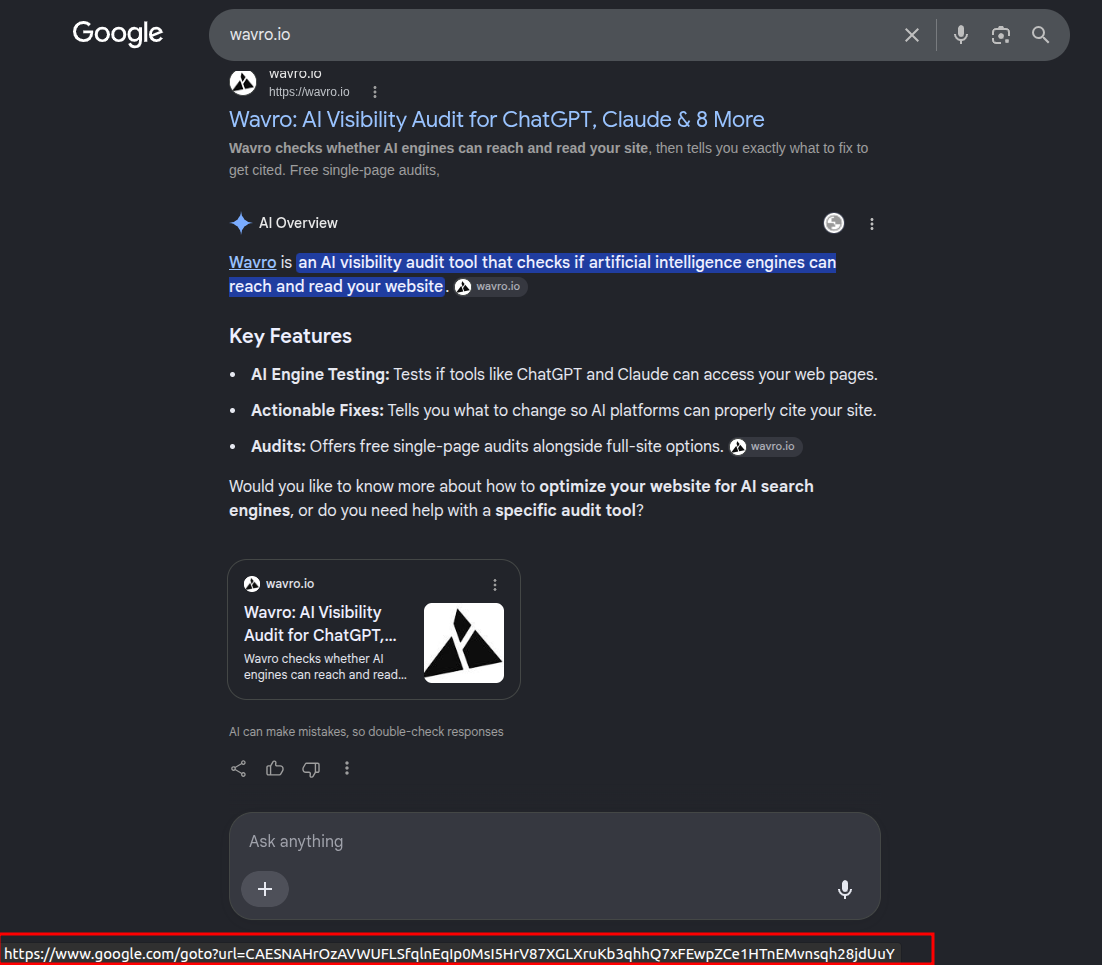
This matters for platforms tracking AI Overview citations. They need to identify the actual source page and domain rather than storing Google's intermediate URL.
Google AI Mode is also now showing goto tracking URLs
The same URL-resolution challenge applies to Google AI Mode, where Google provides AI-generated responses with links to supporting webpages.
For AI visibility systems tracking AI Mode sources, the actual destination still needs to be resolved and mapped correctly.
The workflow can look like:
AI Mode → Source Link → Google Redirect → Source URL → Source Mapping
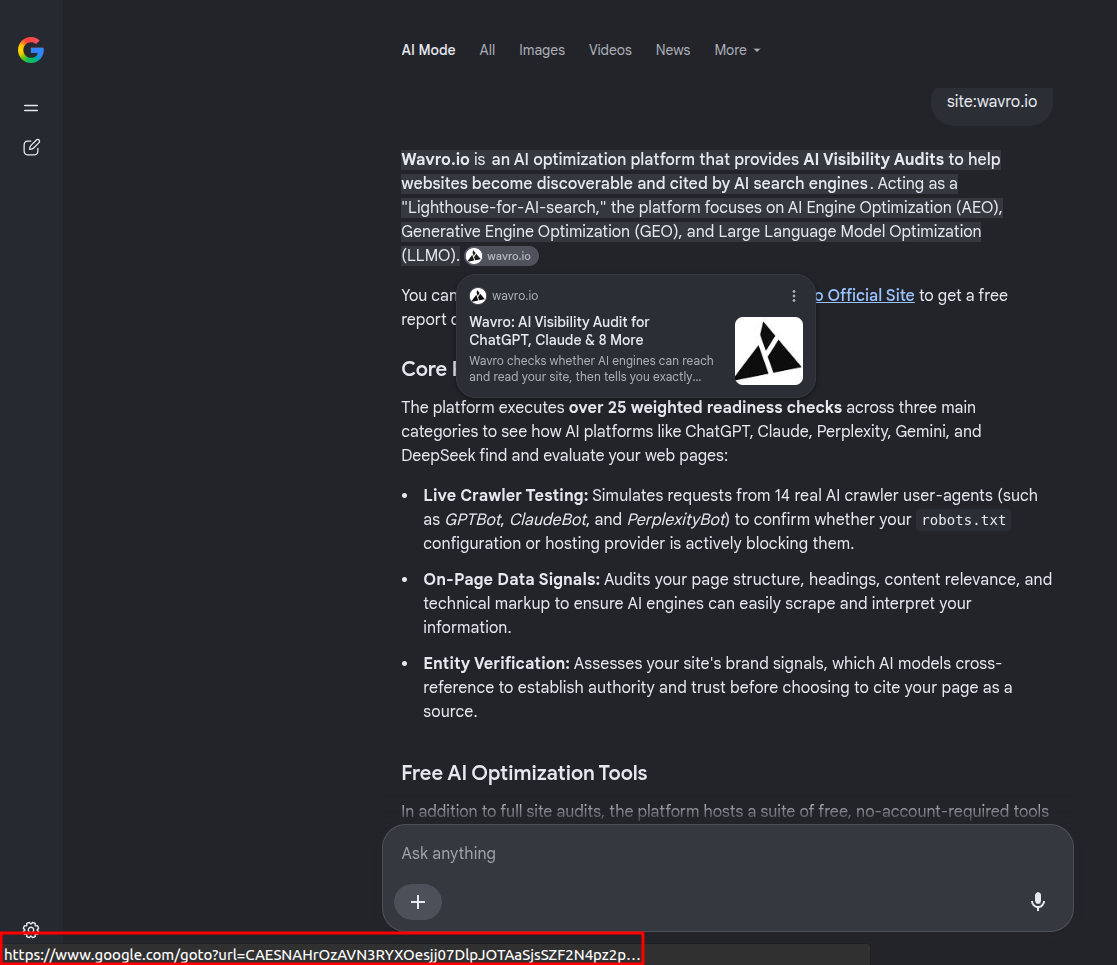
Across all three surfaces we tested, organic results, AI Overviews, and AI Mode, the link format was the same. This is a single mechanism applied to Google's whole result surface, not three separate changes to handle.
How Google's goto tracking URL affects AI visibility platform citations
For AI visibility platforms, the key issue is accurate source and URL mapping.
A platform tracking Google's search ecosystem may now need to handle:
- Traditional SERP ranking URLs
- AI Overview source URLs
- AI Mode source URLs
If the Google redirect is not resolved correctly, a platform could record Google's intermediate URL instead of the actual webpage that earned the ranking or citation. That leads to inaccurate visibility and citation data.
What website owners should do to optimize it
For most website owners, nothing needs to change because of this update.
Your actual URLs have not changed, and you do not need to modify your website to accommodate google.com/goto.
The important thing is to make sure the tools you use for SEO and AI visibility correctly handle Google's new URL structure.
Continue focusing on the fundamentals:
- Keep URLs clean and stable.
- Maintain a clear website structure.
- Keep important pages crawlable and indexable.
- Keep structured data accurate.
- Monitor search rankings and AI visibility.
Why Google is tightening access to its SERP and AI data
Google is increasingly controlling how its Search and AI result data is accessed.
For users, the experience remains almost identical. For systems collecting this data at scale, however, there is now an additional layer between the Google result and the actual webpage.
This makes URL resolution and source mapping increasingly important for SEO platforms, SERP data providers, and AI visibility tools.
Key takeaways on Google's goto tracking URL change
Google's google.com/goto rollout changes the links behind its results, not the destination URLs themselves.
Our testing showed the request moving through a 302 redirect before reaching the final URL with a 200 response.
For users, the change is barely noticeable. For SERP scrapers and SEO tools, it creates an additional URL-resolution challenge. For AI visibility platforms, the same issue matters when tracking AI Overview and AI Mode sources and citations.
The website does not need to adapt to the goto URL. The systems measuring Google's Search and AI visibility do.
Frequently asked questions about Google's goto URL
Does Google's goto URL affect my website rankings?
No. The change affects the link Google puts in front of your page, not how your page is ranked. Your position in the results, the destination URL, and the way Google evaluates the page are all unchanged.
As a website or blog owner, do I need to fix anything?
No. There is nothing to fix on your side. Your URLs have not changed and no site-level adjustment is required. The systems that need to adapt are the SEO tools and AI visibility platforms that read Google's results.
I searched on Google and I do not see goto URLs. Why?
The most likely reason is that your browser is serving cached results. Try the same query in an incognito or guest window, which loads the page without your existing cache or session.
How can I test this myself?
Open a terminal, which is Terminal on macOS and Linux or PowerShell on Windows, and run the curl command from the technical testing section above against a goto URL you captured from a live result. It prints the redirect chain, so you should see a 302 from the Google URL followed by a 200 from the destination.
Could Google revert this change?
Yes. Google is within its rights to roll this back, narrow it to certain regions or query types, or change the URL format again. It is worth building URL resolution so it handles both direct and goto links rather than assuming either one is permanent.