
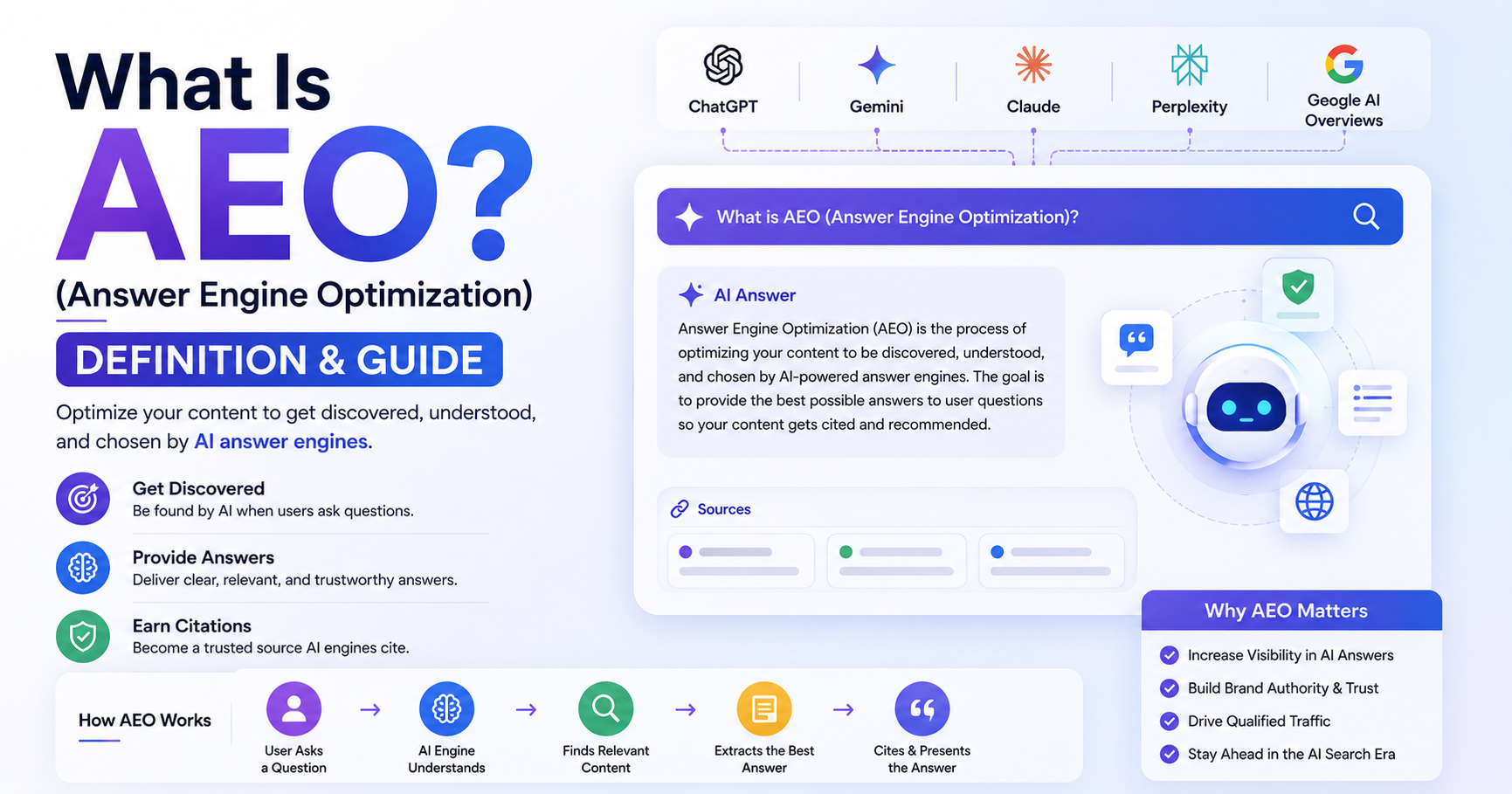
AEO (Answer Engine Optimization): definition
Answer Engine Optimization (AEO) is the practice of structuring web content so that AI-powered answer engines, including ChatGPT Search, Perplexity, Google AI Overviews, and Anthropic Claude, extract and cite it directly in their generated answers.
Where traditional SEO optimizes for a ranked list of blue links, AEO optimizes for inclusion inside the answer itself. The unit of success is a citation, not a click.
Why AEO matters now
Search behavior is shifting from "look up ten sites" to "read one AI answer." Some current numbers that quantify the shift:
- 68% of US Google searches ended without a click in the first four months of 2026, up from 60% in 2024 (SparkToro / Similarweb zero-click study, 2026). The searcher gets their answer from the results page itself.
- Google AI Overviews now appear on roughly 48% of queries, up from 13% in March 2025 (Semrush AI Overviews study, July 2026).
- ChatGPT reached 900 million weekly active users (OpenAI, February 2026). A growing share of research queries never touch a search engine.
If your content isn't structured for extraction, you don't appear in the answer, even if you rank on page one.
How AEO differs from SEO
The mental model shift is that the AI is the reader now, not the human. That changes what "good" looks like:
- Content shape: answer-first paragraphs (BLUF, bottom line up front) beat introductions that build to a point.
- Structure: semantic HTML5 landmarks and short paragraphs (40–80 words) are what make a passage cleanly liftable. JSON-LD helps a parser read the page unambiguously; on current evidence it is not a citation lever on its own.
- Entity resolution: an Organization schema with
sameAslinks to Wikidata, LinkedIn, and Crunchbase is how an engine connects your domain to a real-world entity. That is a different job from getting a passage quoted, and it is the strongest case for structured data.
Three concrete AEO techniques
- Add FAQPage schema with real questions your audience asks. It will not guarantee citations, and the largest published test found no measurable uplift, but it removes ambiguity for any parser reading your page, labelling a block of text as a question and its answer rather than leaving that to be inferred from layout. (Schema.org spec)
- Write direct-answer paragraphs (40–75 words) under question-format headings. This is the exact shape ChatGPT and Perplexity extract as citations.
- Chunk long content into 60–120 word paragraphs so retrieval-augmented generation (RAG) systems can lift a single passage cleanly.
Get an AEO score for your site
Run an AI visibility audit on your site. It grades every page against 25+ AEO, GEO, and LLMO checks and generates the exact JSON-LD, meta descriptions, and content fixes to close each gap. Or get the fixes implemented.