Search is quietly splitting in two.
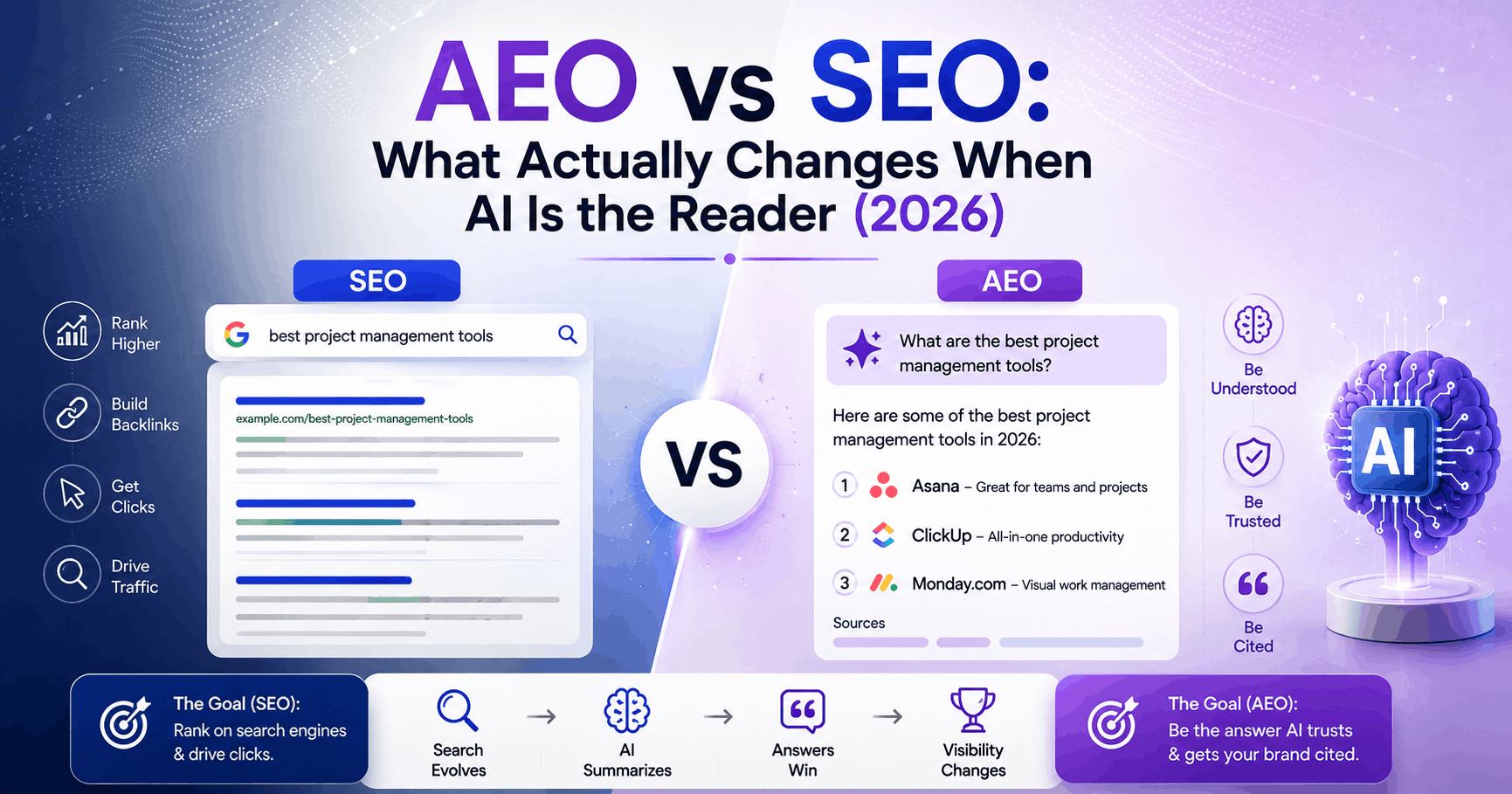
On one side, the search engine you know: a ranked list of ten blue links, backlinks and E-E-A-T carrying most of the weight. On the other, a new class of answer engines: ChatGPT Search, Perplexity, Claude, and Google's AI Overviews, which summarize your content into a single generated answer before showing the source.
If your only playbook is traditional SEO, you're optimizing for the smaller half of a shrinking pie. This is what AEO (Answer Engine Optimization) exists to fix, and here's what actually changes when the AI is the reader.
The scale of the shift
The numbers moved fast in 2024–2025 and are still moving:
- 68% of US Google searches ended without a click in the first four months of 2026, up from 60% in 2024 (SparkToro / Similarweb zero-click study, 2026). The searcher gets their answer from the results page.
- Google AI Overviews now appear on roughly 48% of queries, up from 13% in March 2025 (Semrush AI Overviews study, July 2026).
- ChatGPT reached 900 million weekly active users (OpenAI, February 2026).
If you're not being extracted, you're not being cited. If you're not being cited, you're not on the page anymore.
AEO vs SEO: the side-by-side
| Dimension | Traditional SEO | AEO (Answer Engine Optimization) |
|---|---|---|
| Primary reader | Googlebot + human clicker | LLM (GPT-4, Claude, Gemini, Perplexity's Sonar) |
| Success metric | Rank position + click-through rate | Citation frequency + share of AI answers |
| Content shape | Long-form, keyword-dense, backlink-earning | Short direct answers (40–75 words), chunked, schema-marked |
| Winning signal | Backlinks + domain authority | Structured data + entity clarity + passage extractability |
| Crawlers that matter | Googlebot, Bingbot | Googlebot, GPTBot, ClaudeBot, PerplexityBot, Google-Extended, CCBot |
| Ranking timeline | Weeks to months for a new page | Immediate for well-structured content the LLM can extract |
| Losing failure mode | Getting outranked | Not being cited even when relevant |
Both practices share ~70% of the same fundamentals: proper indexing, quality content, semantic HTML. The overlapping 70% is table stakes. It's the remaining 30%, the AEO-specific work, that determines whether you appear in AI answers.
What changes concretely: three shifts to make now
1. Schema markup goes from "nice to have" to "load-bearing"
For classical SEO, JSON-LD gives you rich results (star ratings, FAQ accordions in search). For AEO, schema is how the LLM builds a confident model of what your page IS and what facts to trust. Structured data is what lets an LLM state facts about your page without inferring them from layout, which is why FAQPage, Organization and Article schema carry the most weight in our LLMO scoring.
Minimum viable schema stack for AEO:
Organizationsitewide (withsameAscross-references)ArticleorProductper detail pageFAQPageon any page with a real Q&A sectionBreadcrumbListfor navigation context
2. Content shape shifts from "essay" to "answer + evidence"
Traditional SEO rewards long-form (1500+ words) with dense keyword coverage. AEO rewards passage extractability: the LLM needs to lift a self-contained 40–120 word chunk that answers the query.
Practical rules:
- Every H2 should be either an entity claim ("Wavro is an AI-visibility audit tool") or a question ("How does AEO differ from SEO?").
- Follow every question heading with a direct 40–75 word answer paragraph, no wind-up.
- Break walls of prose into ordered lists or tables when the content is structural.
3. Distribution now includes bot access
For SEO, robots.txt was mostly "let Googlebot in." For AEO, you're choosing between 14 distinct AI crawler user-agents: GPTBot, ClaudeBot, PerplexityBot, Google-Extended, CCBot, Applebot-Extended, and Meta-ExternalAgent among others.
Blocking them by default (some CDN presets do) is like blocking Google in 2005: a cheap decision with an expensive consequence. Check your current state with our free bot access checker before making a call.
When to prioritize AEO vs SEO
- Prioritize SEO if: your traffic is transactional (products, local services) where clicks convert directly to revenue, and your buyers still Google specific product names.
- Prioritize AEO if: your traffic is research-heavy (B2B SaaS, financial services, education, healthcare) where the user's journey starts with a broad question the AI now answers.
- Do both if: you're mid-market or above. The 70% overlap means most work counts twice.
A pragmatic AEO checklist
Run this on your top-10 pages first:
- Single, descriptive
<h1>per page - Meta description 80–200 chars, answer-shaped
- Schema.org JSON-LD present (at minimum
Article+Organization) - Question-format H2s where content permits, each followed by a 40–75 word answer
- At least one 3–10 item list per page (featured snippet + AI list-answer eligible)
- robots.txt explicitly handles the major AI crawlers
sameAslinks from your Organization schema to Wikidata, LinkedIn, and Crunchbase- Semantic HTML5 landmarks (
<article>,<main>,<section>) - Canonical URL set
- Publish/update date visible + in schema
The takeaway
AEO isn't a replacement for SEO. It's the next layer of the same discipline. The sites winning AI citations in 2026 aren't the ones with the loudest keyword strategies. They're the ones whose content is structured cleanly enough for an LLM to quote from with confidence.
The gap between "good SEO" and "good AEO" is small, but the compounding is real: sites that get cited by ChatGPT and Perplexity build authority that traditional SEO can't touch, because the citation itself is a persistent third-party endorsement.
See where your site stands
Run an AI SEO audit on your own site. It scores your page against 25+ checks across AEO, GEO, and LLMO, and generates the exact JSON-LD, alt text, and content-structure fixes for every failing check. Takes about 60 seconds. Or get the fixes implemented end-to-end.